
A conference is one of the most expensive things a company or association does all year, and the photographs are what remain when the room empties. They become next year's marketing, the sponsor recap deck, the press coverage, a speaker's new LinkedIn profile, and the internal reel that justifies the whole budget. Yet event photography is one of the most misunderstood lines in the plan - part craft, part logistics, and priced a dozen different ways.
This guide is written for the people who plan and pay for conferences, drawn from years of photographing them, from PyCon and professional-association annual meetings to energy-sector conferences and corporate summits. It covers what the photos are actually for, what they cost in 2026, how to hire the right photographer, what a strong shot list looks like, and the licensing and insurance details most guides skip. We lean on Pittsburgh for local specifics, but the pricing and the playbook apply nationally.
What Conference Photos Are Actually For
Before you can budget for photography, it helps to be clear on what the images have to do. Great conference coverage is not a souvenir. It is content that works for a full year:
- Selling next year's event. Crisp, energetic photos of a packed room are the single most persuasive asset in next year's registration page and sponsor prospectus.
- Delivering sponsor value. Sponsors pay for visibility. Documented logos, activations, and branded moments are proof of the exposure they bought, and they make renewals easier.
- Feeding press and social. Same-day images let your comms team post while the event is live and hand clean, captioned photos to media.
- Building personal brand. On-site headshots and speaker portraits become the LinkedIn and bio photos attendees actually use, keeping your event in front of them long after it ends.
- Justifying the budget internally. A polished recap gallery is how event teams show leadership what the investment produced.

How to Hire a Conference Photographer
Most buyer's guides tell you to compare portfolios and get a few quotes. That is the easy part. Here is what actually separates a photographer who will deliver from one who will leave you with a folder of dark, blurry stage shots.
Five Things That Actually Matter
- Documentary instinct. Conferences are photojournalism, not portraiture. You want someone who reads a room, anticipates the handshake and the laugh, and captures moments without staging them.
- Low-light and stage-lighting skill. Ballrooms are dark, stages are lit for the audience's eyes rather than a camera, and LED walls wreck exposure. This is a technical specialty, not a setting.
- Speed and turnaround. If your comms team needs images while the event is live, the photographer needs a same-day workflow. Ask, specifically, what they can deliver and when.
- Multi-day consistency. Across two or three days and multiple shooters, the images should look like one event. Consistency is a sign of a seasoned pro, not luck.
- Crew capacity. A photographer who can staff a second shooter, a headshot station, and a video operator from one point of contact saves you from coordinating three vendors.
Questions to Ask Before You Book
- Can I see two or three full galleries, not just highlights?
- Have you shot this venue, or one like it, before?
- Will you personally shoot my event, or an associate?
- How do you cover concurrent sessions and a main stage at the same time?
- What is your guaranteed turnaround, and can you deliver same-day selects?
- Exactly what usage rights are included, and can sponsors and press use the photos?
- Do you carry liability insurance, and can you provide a Certificate of Insurance for my venue?
- What is your backup plan if a camera fails mid-keynote?
Red Flags
Walk away from delivered images that arrive watermarked, licensing so restrictive you cannot use photos in an ad or hand them to a sponsor, a portfolio with no recent multi-day conference work, or a photographer who cannot produce proof of insurance. Any one of these turns a bargain into a liability.
Conference & Event Photography Pricing in 2026
Pricing varies by duration, crew size, turnaround, and market, but the ranges below reflect where independent US sources converge for professional corporate and conference work. Treat them as the reliable middle, not the floor or the ceiling.
Pricing at a Glance
| Coverage | Typical US rate | Edited images |
|---|---|---|
| Hourly (2-hour minimum) | $200 - $350/hr | 50 - 100 per hour |
| Half day (about 4 hours) | $1,200 - $2,500 | 150 - 300 |
| Full day (about 8 hours) | $2,500 - $4,500 | 300 - 600+ |
| Multi-day conference | from $4,000 flat | 1,000+ |
| Second photographer | +$1,200 - $2,000/day | varies |
Day rates are better value per hour than stacking hourly blocks, which is why most conferences are booked as half-day, full-day, or flat multi-day projects. In major coastal metros like New York and San Francisco, expect the professional band to start higher, often $3,500 to $7,000 for a full day and $9,000 or more for multi-day team coverage.
What Drives the Cost Up or Down
- Hours and days of coverage. The biggest single factor.
- Number of photographers. Driven by attendee count and simultaneous sessions.
- Turnaround speed. Same-day and next-morning delivery carry the largest premiums because they require an on-site editor.
- Scale and venue. More rooms, larger footprints, and heavy sponsor documentation push toward more coverage.
- Usage and licensing rights. The quiet multiplier. Standard packages cover internal and basic promotional use; broad commercial advertising rights cost more and are best negotiated before the event.
Common Add-Ons
| Add-on | Typical cost |
|---|---|
| On-site headshot station | $250 - $600/hr (about $3,000 half day, $5,500 full day) |
| Same-day / rush editing | +10% to 50% of base |
| Event highlight video | $500 - $4,000 by scope |
| Drone coverage | about $300 |
| Extended commercial licensing | negotiated separately |
How to Budget
A useful rule of thumb: allocate 2 to 4 percent of a smaller event's total budget to photography and video, rising to 5 to 8 percent for a major conference. On a $100,000 conference, that is roughly $5,000 to $8,000 for professional photo and video coverage.
What It Costs in Pittsburgh
Mid-size markets like Pittsburgh, Cleveland, and Columbus deliver major-metro quality without rates inflated by coastal cost of living. If you are booking locally, this is the band to expect:
| Coverage | Pittsburgh range |
|---|---|
| Hourly | $150 - $300 (specialists to about $400) |
| 2-hour corporate shoot | $400 - $600 |
| Half day (about 4 hours) | around $1,500 |
| Full day (about 8 hours) | around $2,800 |
| Multi-day conference | national base, toward the lower end |
For a deeper look at local event coverage and packages, see our Pittsburgh event photography and conference photography pages.
The Conference Photography Shot List
The single best thing you can do for your photographer is share the run of show a week out. From it, a good shot list writes itself. Strong conference coverage captures every one of these categories:
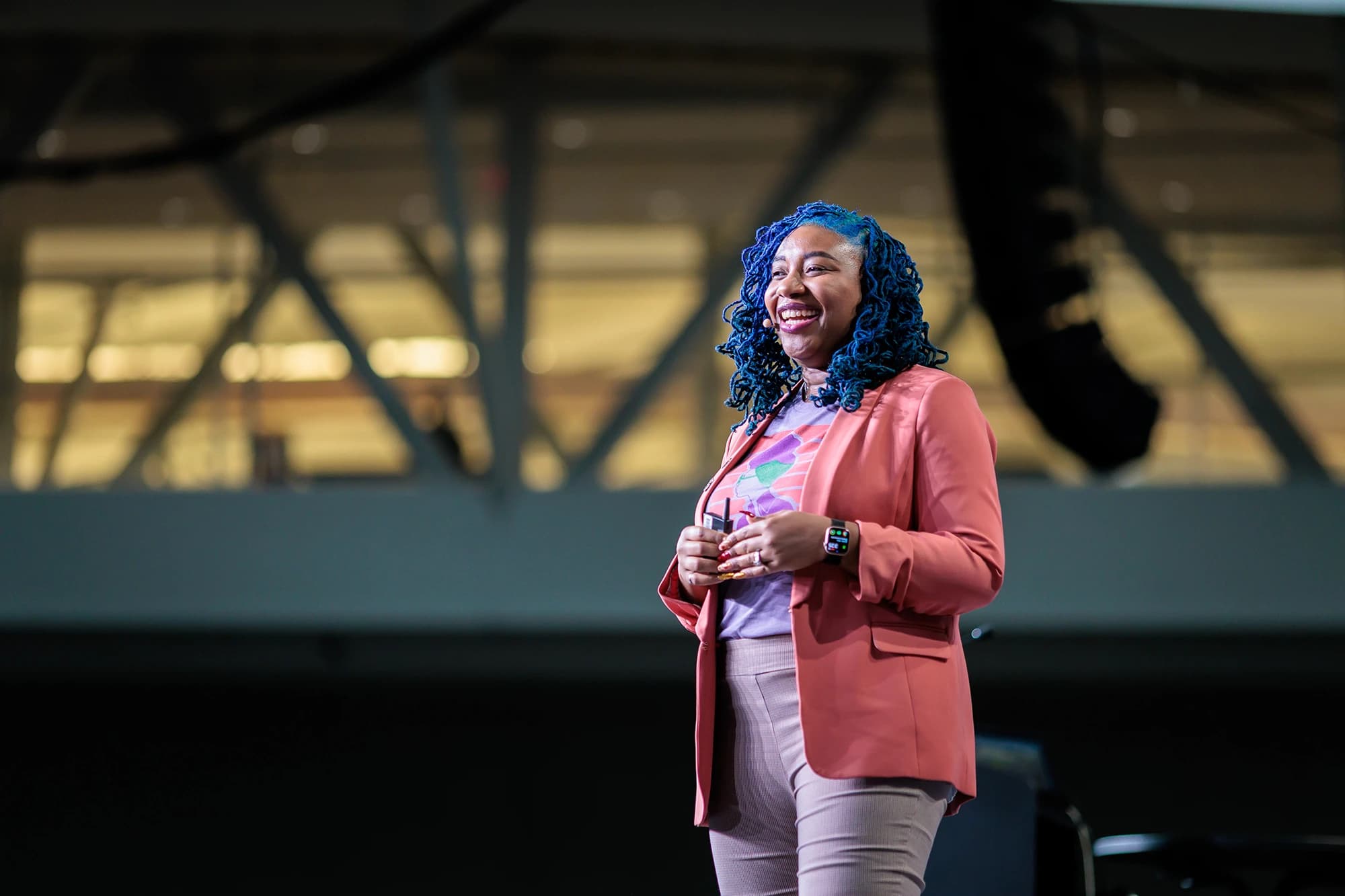
- Stage and speakers. Keynotes framed with visible event branding, tight speaker portraits, panels, and audience Q and A. A podium-wide shot that shows the full stage and screens.
- Audience and engagement. The packed-room wide shot, reactions, note-taking, laughter, applause. These sell the energy of the event.
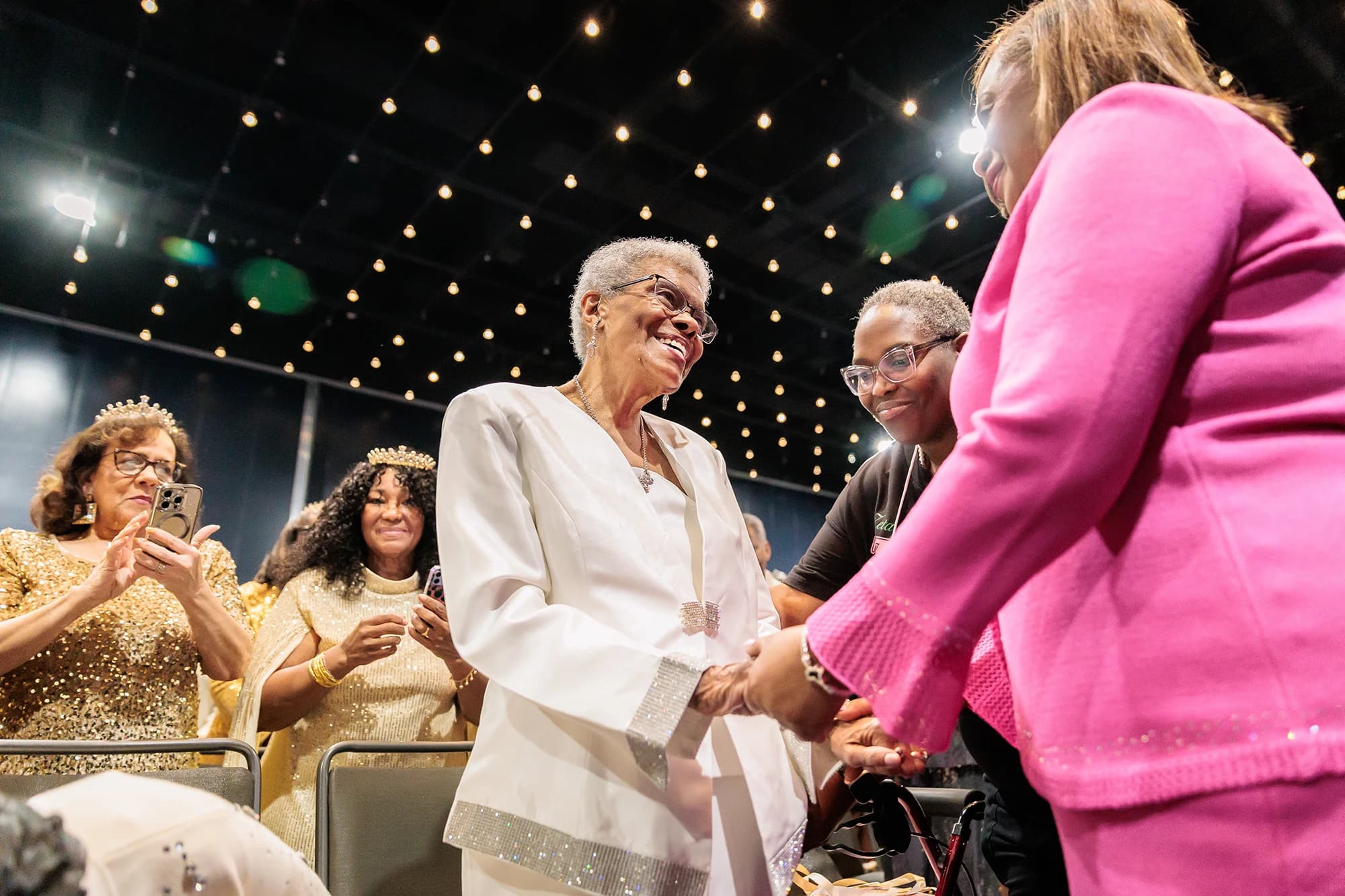
- Networking and candids. Conversations in the hallway and at receptions. These are the most-reused marketing images, year after year.
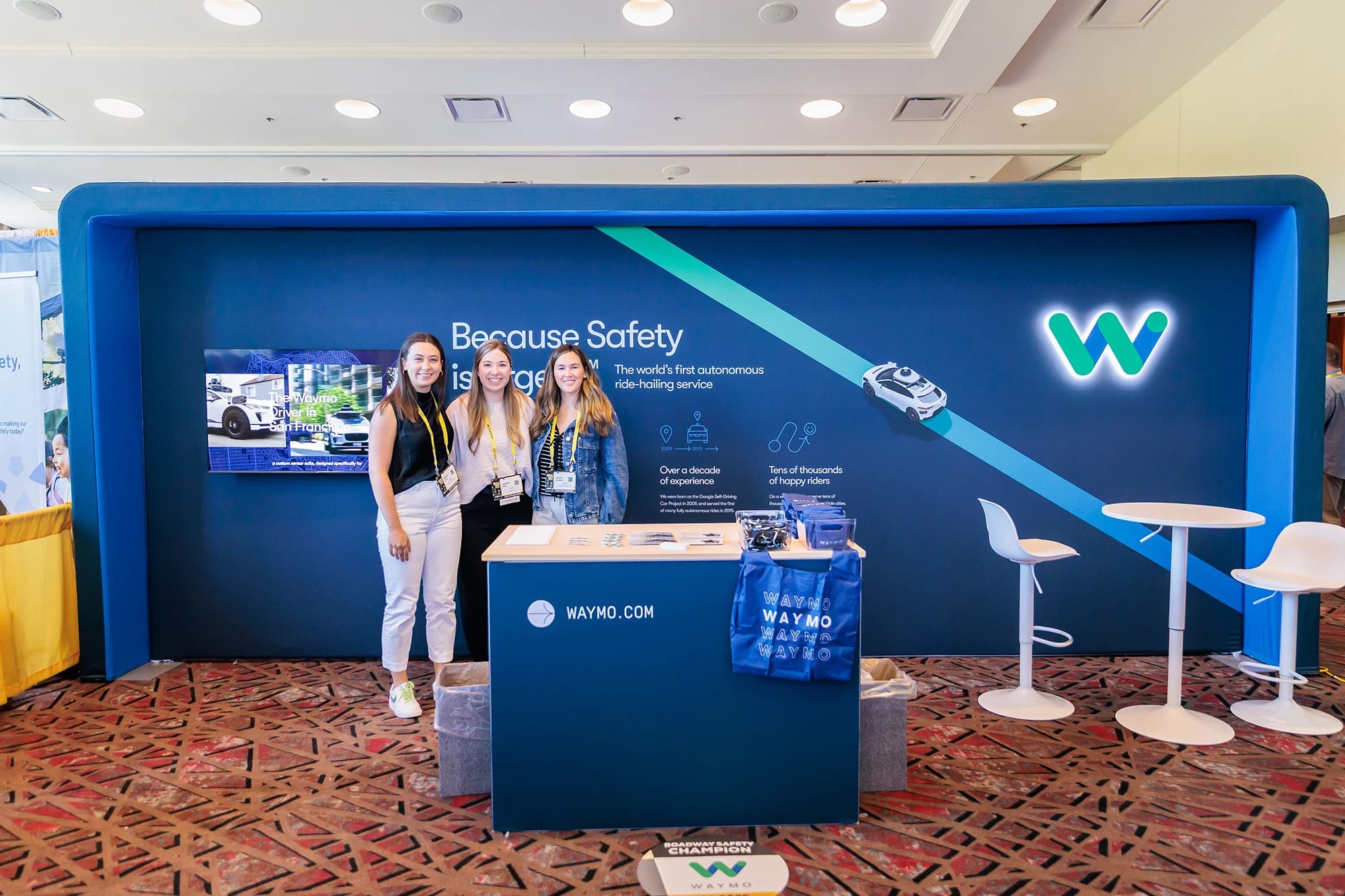
- Sponsors and branding. Every sponsor logo, banner, and activation, organized so each sponsor gets its own folder. Bring a logo-placement map if you have one.
- Details and venue. Registration, signage, decor, catering, and clean establishing shots of the empty room before doors open.
- VIPs, awards, and groups. Choreograph the on-stage award handoff in advance so nobody is caught mid-blink, and schedule group photos when people are actually in the room.
On-Site Headshot Stations
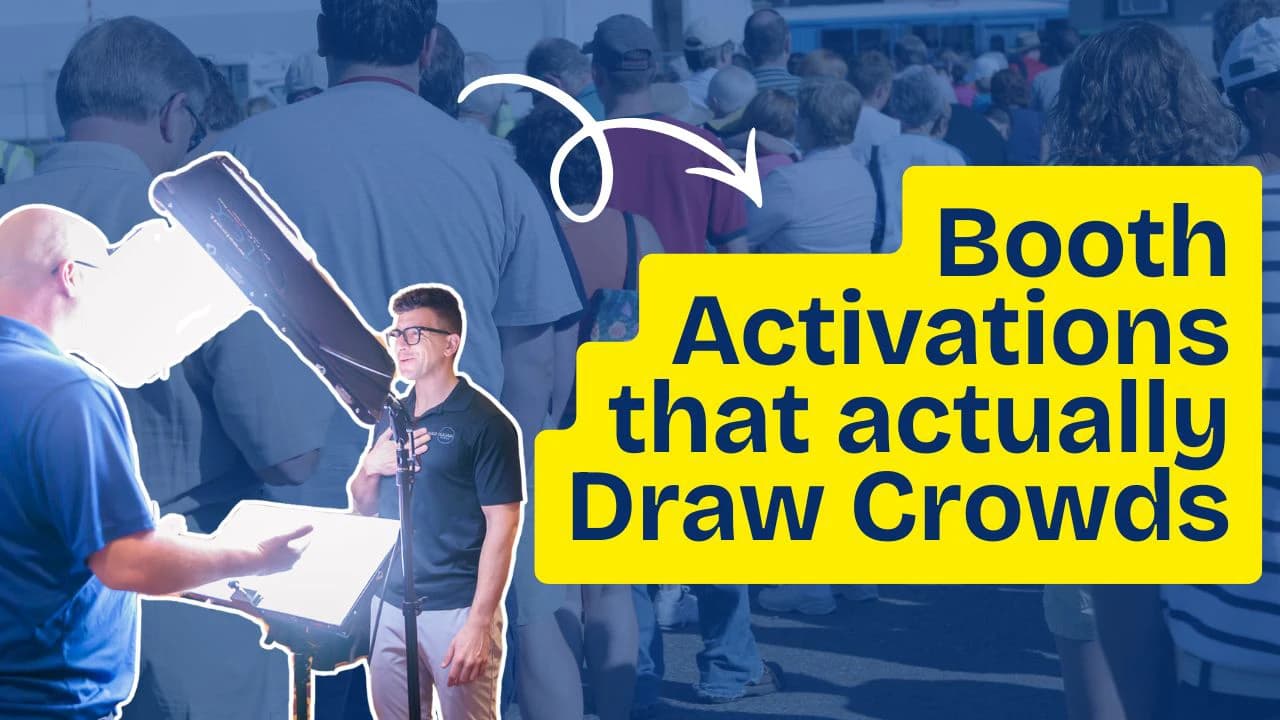
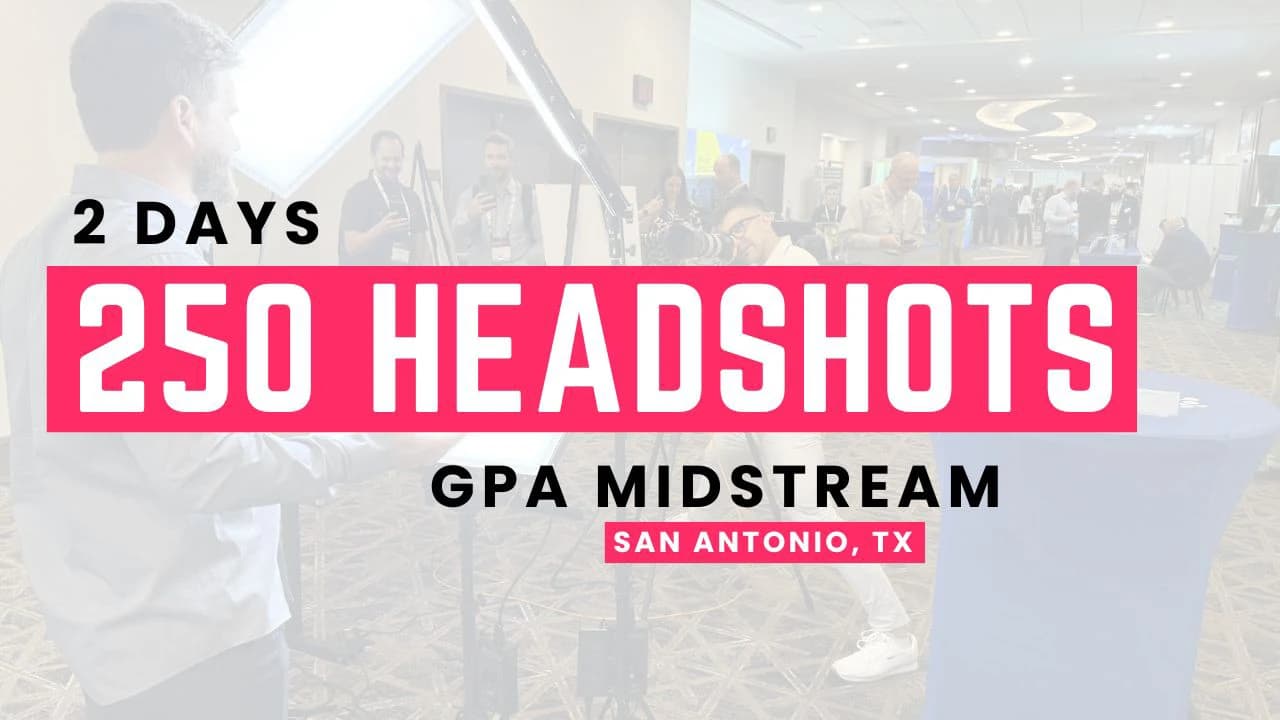
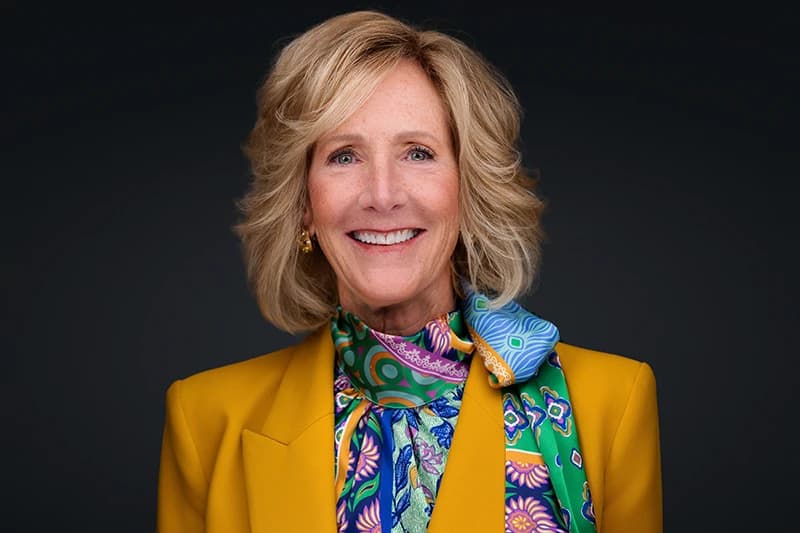
One of the fastest-growing requests in conference photography is a professional headshot station on the exhibit floor. It is a genuine attendee perk: guests walk away with a polished LinkedIn photo, and your event gets remembered as the one that delivered real value. Sponsors love branding them, too.
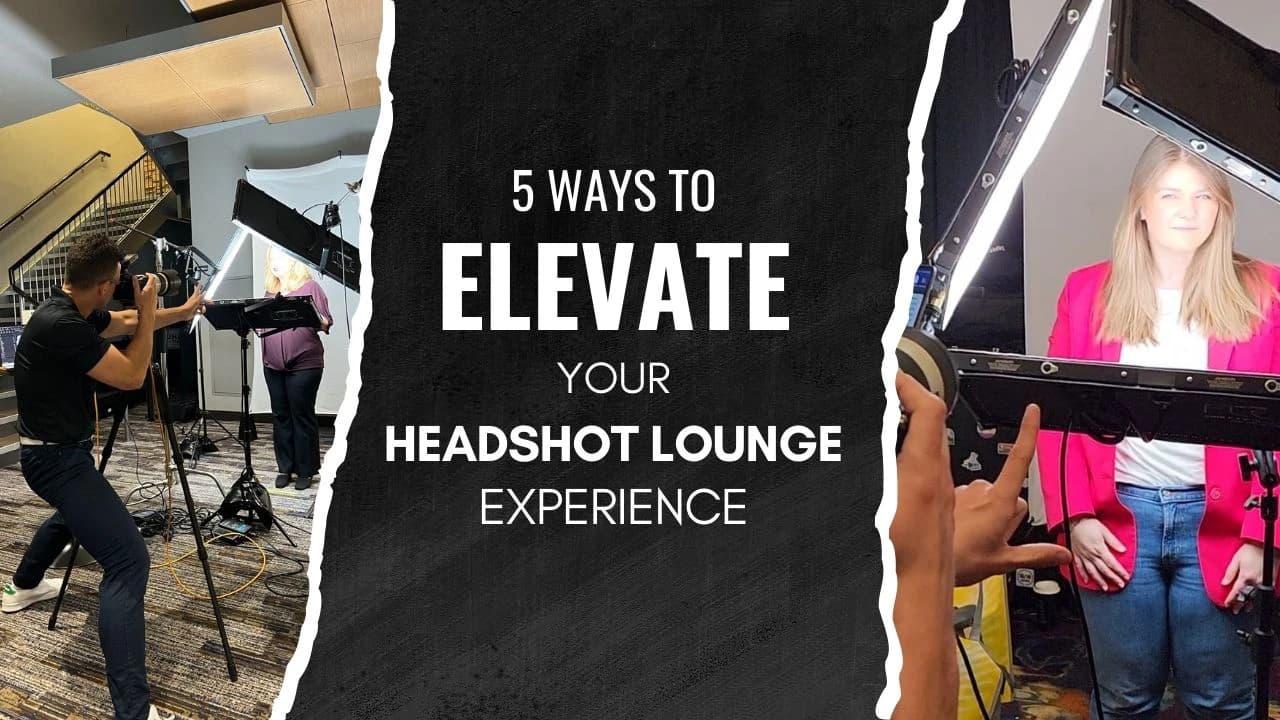
The mechanics matter. A working station needs a backdrop, controlled lighting, tethered capture for instant review, and enough footprint to keep a line moving. Plan for throughput of roughly 15 to 25 people per hour depending on the setup, schedule it around session breaks when traffic peaks, and offer same-day delivery by QR code or live gallery so attendees get their images before they leave.
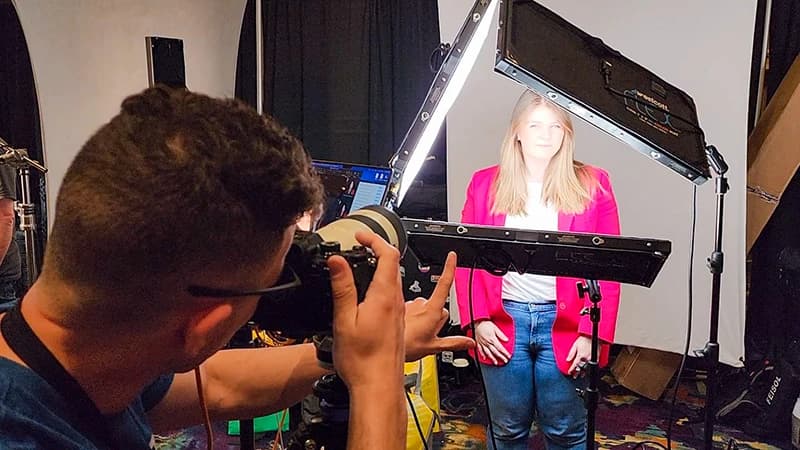
We run these regularly. Learn more about our tradeshow and conference headshot booth, or our convention headshot lounge if you are hosting it as an attendee amenity rather than a sponsor activation.
Why Conference Photography Is Technically Hard
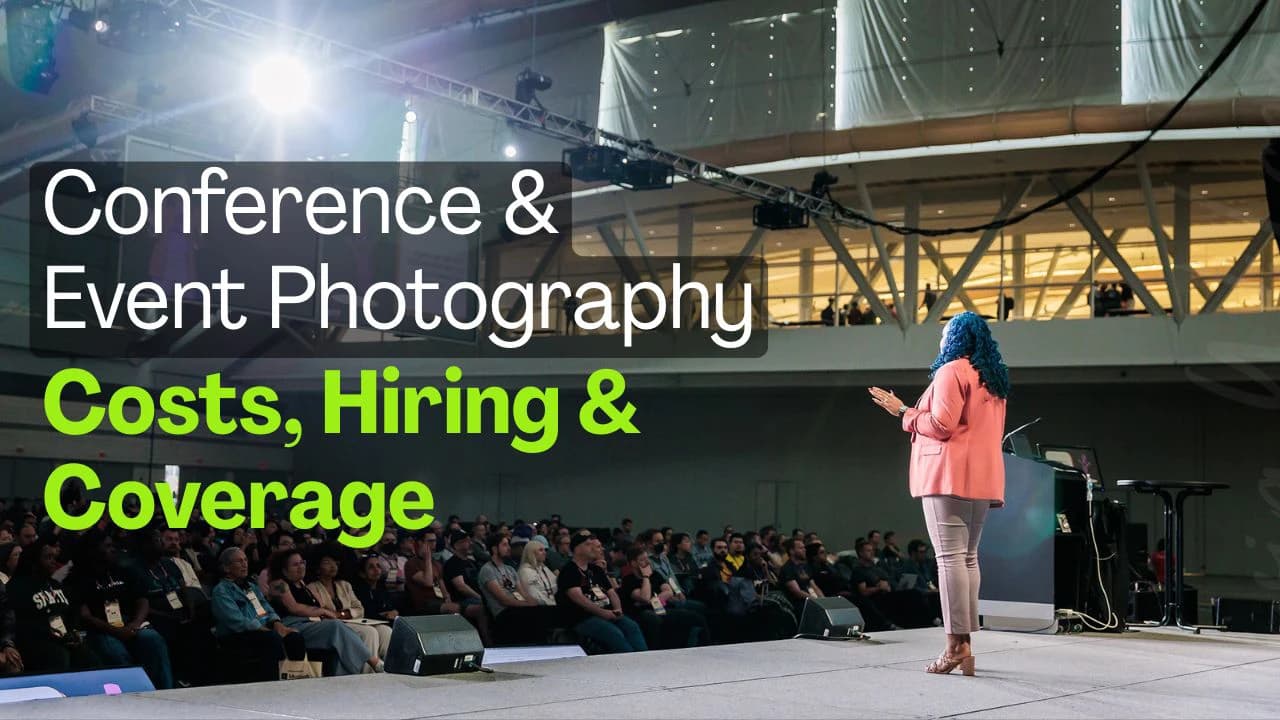
This is the part buyers rarely see, and it is exactly why professional coverage is worth the cost. A modern conference stage is one of the most difficult lighting environments in photography.
- Mixed and colored stage light. RGB stage washes throw color casts that have to be corrected in real time, or every speaker turns magenta.
- LED walls and projection screens. Bright video walls behind a speaker fight the camera for exposure and can produce banding or moire if the shutter is not synced to the screen. Getting a keynote sharp against a glowing 40-foot LED wall is a skill, not a preset.
- Backlit speakers and high contrast. Stages are lit for the audience, leaving speakers rim-lit and dark-faced unless the photographer knows how to expose for it.
- No flash allowed. During talks, flash is off the table, so the work depends on fast lenses, high ISO, and clean noise handling.
A photographer who can walk into that environment and deliver publishable frames without disrupting the room is what you are actually paying for.
Day-of Logistics and Coverage
- Blend in. A conference photographer should move like a guest, dressed to match the room, working from the edges, never blocking sightlines.
- Credentials and access. Larger venues require media credentials and have rules about stage access. A pro plans this with your team in advance.
- Multi-track coverage. When several sessions run at once, decide ahead of time which get a photographer, whether a shooter roves or stays on the main stage, and how a second photographer splits the load.
- Silent and unobtrusive. Silent shutters and documentary movement keep the focus on your program, not the person photographing it.
Deliverables, Turnaround, and Same-Day Delivery
Know what you are getting before you sign:
- Volume. Roughly 50 to 100 edited images per hour of coverage. Edited means culled to the best frames, color-corrected, and cropped, not every shutter click.
- Sneak peek. A curated set of 20 to 30 images within 24 to 48 hours is now standard for corporate work.
- Full gallery. Most professionals deliver the complete edited gallery in about three to five business days, sometimes up to two weeks for very large events.
- Same-day and press workflow. For live posting, ask about on-site culling, tethering, and a real-time gallery. If images go to press, ask about embedded captions and metadata so photos arrive newsroom-ready.
- Delivery. A downloadable online gallery is the norm, organized by day, session, and sponsor.
Who Owns the Photos? Licensing in Plain English
This trips up more buyers than pricing does. In almost every case, the photographer owns the copyright and grants you a license to use the images. What matters is the scope of that license:
- Internal and promotional use should be included in any corporate package: your website, social, email, decks, and internal comms.
- Commercial advertising - using a photo in paid ads - is often a separate, higher tier. Ask up front if you plan to run ads.
- Sublicensing is the right to pass images to sponsors and press. Confirm it is included if sponsors expect photos.
- Exclusive vs non-exclusive determines whether the photographer can reuse the images in their own portfolio. Non-exclusive is standard and keeps your price down.
Get the usage scope in writing before the event. Expanding rights afterward almost always costs more than negotiating them in.
Contracts, Insurance, and the COI Your Venue Will Ask For
The paperwork nobody writes about, and the paperwork that stalls bookings:
- Certificate of Insurance (COI). Most convention centers and hotels require the photographer to carry liability insurance and to name the venue as additionally insured on a COI. Ask for this early; a photographer who cannot produce one may not be allowed to work.
- Payment terms. Corporate clients often run on purchase orders and NET-30 invoicing and will need a W-9. Confirm the photographer can work that way.
- The contract itself. A solid agreement covers deposit and cancellation terms, overtime rates, the deliverable and turnaround, usage rights, and a backup-equipment clause.
Conference & Event Photography in Pittsburgh
Pittsburgh has quietly become a strong business-event city. The David L. Lawrence Convention Center anchors the largest conferences, while venues like the Sheraton at Station Square host mid-size meetings and galas. Much like the city's 90-plus neighborhoods, each industry here - from tech and robotics to healthcare, energy, and finance - brings its own culture and expectations to how it wants to be photographed.
We have photographed that range firsthand, from PyCon to professional-association annual meetings and energy-sector conferences, and we run on-site headshot stations at events across the region. If you are planning something, the fastest way to a real quote is to tell us the venue, the dates, and what you need the photos to do.
Whether you are a seasoned executive, an association director, or an event planner, the images are what your event leaves behind. Choose a photographer who can handle the lights, respect the room, and hand you content that works all year - and the photography stops being a cost and starts being the asset that sells the next event.